


Single-jaw surgery corrects either the upper or lower jaw. Double-jaw surgery repositions both jaws during the same planned procedure. The choice depends on which jaw causes the bite problem and whether both must move to restore balance and function.
People often explore these procedures because of chewing difficulty, jaw strain, breathing concerns or an uneven facial profile. If you are considering jaw surgery, understanding the difference between the two approaches can help you discuss your treatment plan more confidently. This blog explains both types of surgery to clear up any questions.
What Is Corrective Jaw Surgery (Orthognathic Surgery)?
Corrective jaw surgery, also called orthognathic surgery, repositions the jaw bones when braces alone cannot correct their alignment. It can improve the bite, chewing, speech, breathing and facial balance.
Treatment usually combines surgery with orthodontics. Braces align the teeth before the operation and refine the bite afterwards. An oral and maxillofacial surgeon and an orthodontist normally plan the treatment together.
What Is Single-Jaw Surgery?
Single jaw surgery corrects either the maxilla (upper jaw bone) or the mandible (lower jaw bone). It is recommended when one jaw mainly causes the bite or facial imbalance. The repositioned bone is usually secured with small plates and screws.
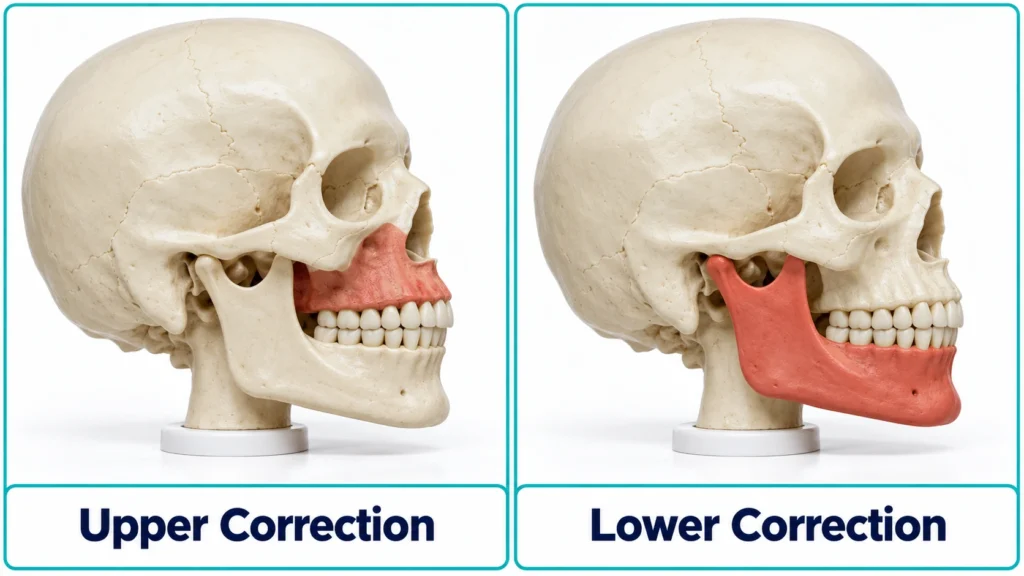
The two approaches are:
- Upper jaw surgery: Moves or widens the maxilla to correct selected crossbites, open bites, gummy smiles or a recessed upper jaw.
- Lower jaw surgery: Moves the mandible forwards or backwards to correct a receding jaw, prominent jaw or uneven bite.
Braces, X-rays, scans and bite records help the surgical team confirm whether correcting one jaw can create stable alignment.
Related Procedures That May Accompany Jaw Surgery
Depending on the problem, treatment may also include genioplasty to reposition the chin, a segmental osteotomy to move one part of a jaw, or surgically assisted palatal expansion to widen a narrow upper jaw. These procedures may support the overall plan but are not separate single-jaw surgeries.
What Is Double-Jaw Surgery (Bimaxillary Surgery)?
Double-jaw surgery repositions the upper and lower jaws in one planned operation. It is also known as bimaxillary surgery, meaning surgery involving both jaws.

This approach may be needed when moving one jaw cannot create a stable bite. It can also address marked facial imbalance, asymmetry or restricted airway space. Although the procedure is more complex, it is carefully planned using X-rays, photographs, 3D scans and digital or physical bite models. These records help the team calculate how each jaw should move.
Single-Jaw vs Double-Jaw Surgery: Key Differences
Single-jaw surgery changes one jaw, while double-jaw surgery coordinates movement of both. The broader the correction, the longer and more complex the procedure may be.
| Comparison | Single-jaw surgery | Double-jaw surgery |
| What is corrected? | Either the upper or lower jaw | Both jaws together |
| Typical surgery duration | About 2–3 hours | About 3–5 hours |
| Typical hospital stay | Around 1–2 nights | Around 2–4 nights |
| Initial recovery | Often 2–4 weeks before returning to work or study | Often 3–6 weeks, depending on the procedure and daily demands |
| Complexity and risk | One jaw is repositioned | More planning and monitoring because both jaws are repositioned |
These ranges are general estimates, not fixed promises. Published patient guidance places orthognathic procedures at roughly two to five hours and hospital stays between one and four days. The exact duration depends on jaw movement and any additional procedures.
Overall, jaw surgery recovery may take longer than the first few weeks. Bone healing generally takes around six weeks, while complete healing can take up to 12 weeks. For a fuller timeline, see our separate jaw surgery recovery guide.
Which Surgery Do You Need? How Surgeons Decide
The correct operation depends on the source and severity of the jaw imbalance. Self-diagnosis is not reliable because two people with similar-looking profiles may need different treatment plans.
Surgeons consider:
- The bite problem: Which jaw is responsible and how far it must move
- X-rays and CT findings: The position, shape and relationship of the jaws
- Facial balance: The profile, chin position and facial symmetry
- Breathing concerns: Snoring, sleep-related breathing problems or restricted airway space
- Orthodontic planning: How the teeth must be aligned before and after surgery
- Jaw-joint health: Existing discomfort, stiffness or restricted movement
Jaw surgery for overbite and underbite is planned individually. An overbite caused mainly by a receding lower jaw may require lower-jaw advancement. An underbite may need upper-jaw advancement, lower-jaw repositioning or movement of both jaws.
Risks to Know Before Choosing Jaw Surgery
The possible jaw surgery risks and complications depend on the operation and the patient’s health. Common concerns include:
- facial swelling and bruising;
- temporary numbness of the lip, chin or cheek;
- infection around the surgical area or fixation plates;
- bite changes requiring adjustment with elastics or braces; and
- rarely, a need for further correction.
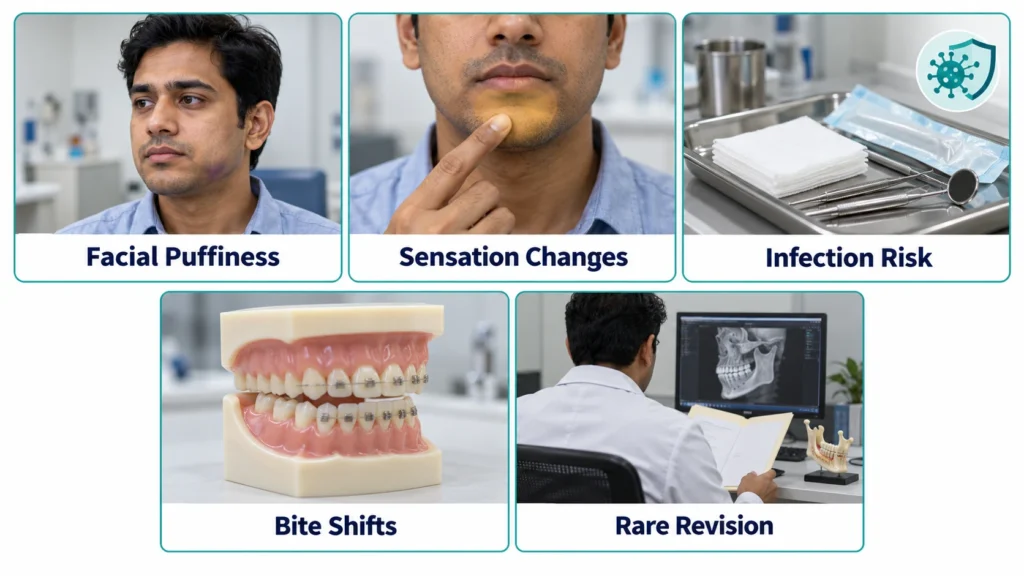
Lower-lip or chin numbness can take several months to settle after lower-jaw surgery and may occasionally persist. Careful planning, an experienced surgical team and proper follow-up help reduce avoidable risks.
Choosing a Hospital or Nursing Home for Jaw Surgery
Choose a facility with an experienced maxillofacial team, suitable imaging, trained anaesthesia support and a clear follow-up system. Jaw surgery requires more than an operating theatre; it needs coordinated planning before and after the procedure.
Look for:
- a complete clinical assessment with X-rays or CT imaging;
- coordination between the surgeon and orthodontist;
- a clear explanation of single-jaw and double-jaw options;
- discussion of expected changes, limitations and risks;
- anaesthesia, inpatient and emergency support; and
- scheduled reviews after discharge.
At Samaritan Hospital, we offer maxillofacial services for jaw correction and other facial conditions. To discuss jaw surgery in Kolkata, patients can book an evaluation today.
The appropriate surgery can only be decided after an individual assessment by an oral and maxillofacial surgeon and orthodontist.
What People Also Ask
Is double-jaw surgery more painful than single-jaw surgery?
Not necessarily. Anaesthesia and medicines help control pain after either procedure. Double-jaw surgery may cause more swelling, tightness, and tiredness because both jaws are treated, but each patient’s experience and medication needs differ.
How long does double-jaw surgery take, and how long is the hospital stay?
Double-jaw surgery often takes around three to five hours. Hospital stay is commonly two to four nights, depending on the procedure and early recovery. The surgical team monitors breathing, hydration, pain and bite stability before discharge.
Can an underbite or overbite be fixed with single-jaw surgery?
Yes, in selected cases. Single-jaw surgery may work when either the upper or lower jaw mainly causes the problem. If both jaws contribute to the underbite or overbite, moving both may create a more stable and balanced correction.
Are braces needed before and after jaw surgery?
Usually, yes. Braces align the teeth before surgery, so they fit correctly after the jaw moves. They normally remain in place afterwards while the orthodontist makes final bite adjustments. The full orthodontic schedule varies between patients.
Will jaw surgery change how my face looks?
Yes, some change is expected because repositioning a jaw also changes the surrounding facial shape. The amount varies with the planned movement. Surgeons use photographs, scans and bite records to explain the likely functional and facial changes beforehand.