

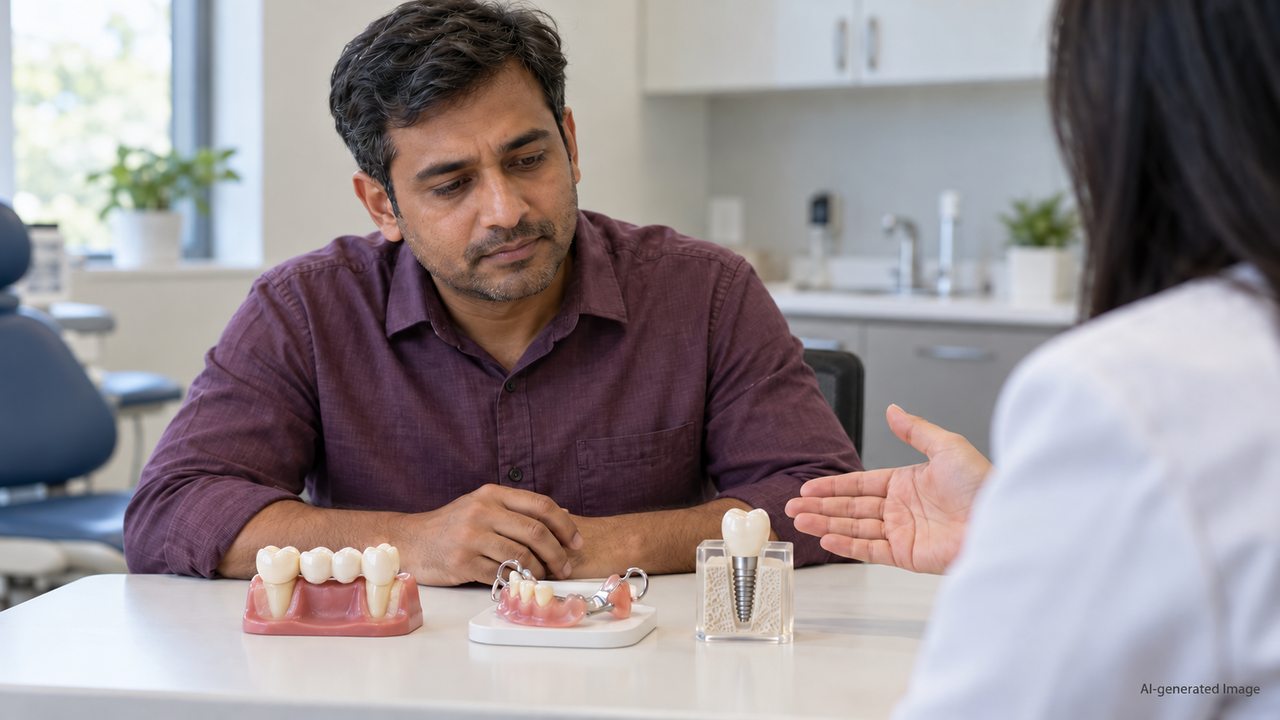
Losing a tooth to decay, an accident or an extraction leaves more than a visible gap. It also raises a practical question: what should replace it?
The three main choices are a dental bridge, dentures, and a dental implant. The right option depends on how many teeth are missing, the health of the gums and jawbone, the condition of nearby teeth, your budget, and the expected lifespan. Each can restore appearance and chewing, but they work differently. An examination and dental scan help determine which one suits your mouth.
Should You Replace a Missing Tooth at All?
Yes, most missing teeth should be replaced. Without support, nearby teeth may gradually move into the space, while the opposing tooth may extend towards the gap. Chewing can also become uneven.
Leaving a space may lead to:
- Tooth movement: Neighbouring teeth may tilt or drift, affecting the bite.
- Chewing problems: Food may become harder to break down on the affected side.
- Jawbone changes: Bone loss after tooth loss can occur because the area no longer receives pressure from a tooth root.
Not every gap requires replacement. For example, certain back-tooth spaces may be monitored. A dentist must assess the bite before recommending this.
Missing Tooth Replacement Options Explained
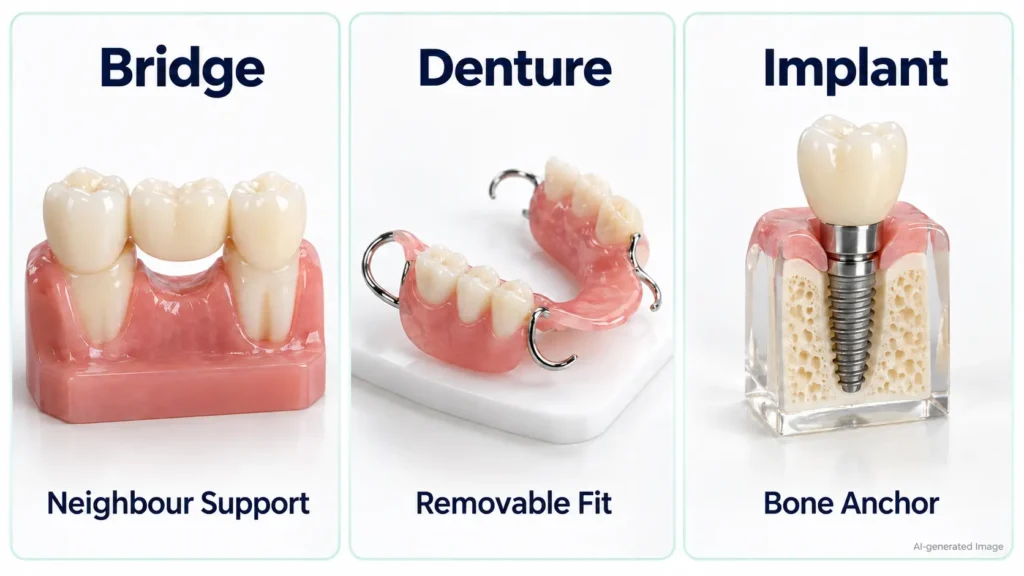
The three established missing-tooth replacement options are a bridge, a removable denture, and an implant. Understanding how to replace a missing tooth begins with knowing how each option is supported.
Dental Bridge
A dental bridge is a fixed restoration that fills a gap with an artificial tooth. A conventional bridge is supported by crowns placed over the abutment teeth—the teeth on either side of the space.
It does not require implant surgery and can feel stable while eating. However, the supporting teeth usually need reshaping, even when they are otherwise healthy. A bridge commonly lasts around 5–15 years, although oral hygiene, bite pressure and the health of its supporting teeth affect its lifespan.
Dentures: Removable Partial or Complete Options
Dentures are removable artificial teeth. A partial denture replaces several missing teeth, while a complete denture replaces all teeth in the upper or lower jaw.
Dentures require no implant surgery and usually have the lowest initial cost. However, they may move slightly while eating or speaking and need regular removal for cleaning. As the gums and jawbone change shape, adjustments are often needed. Many dentures require replacement after roughly 5–10 years, depending on their fit, care and material.
Dental Implant
A dental implant is a titanium post placed in the jawbone to support a crown. It replaces the missing tooth root and functions independently of neighbouring teeth.
An implant can feel like a natural tooth, support strong chewing, and help preserve the underlying jawbone. It requires minor surgery, healing time, healthy gums and enough bone.
When people ask how long dental implants last, the implant post can often remain functional for 15 years or much longer with proper care. The crown fitted above it may need earlier replacement.
Bridge vs Denture vs Implant: Which Suits Your Situation?
No single option is best for everyone. When comparing dental implants vs bridges or implants vs dentures, the condition of your entire mouth matters more than any single advantage.
| Your situation | Option often considered | Why it may fit |
| One missing tooth with healthy neighbouring teeth | Implant | It stands independently and doesn't require filing down nearby teeth. |
| One missing tooth beside heavily filled or crowned teeth | Bridge | Those teeth may already require crowns and can support the replacement. |
| Several teeth missing in a row | Partial denture or implant-supported bridge | Both can replace multiple teeth without fitting one implant for every gap. |
| All or most teeth missing | Complete denture or implant-supported denture | The choice depends on bone, health, stability needs and budget. |
| Limited budget or surgery is medically unsuitable | Removable denture | It is non-surgical and generally has a lower upfront cost. |
These are general examples, not fixed rules. Similar-looking gaps may need different solutions. Only an examination and X-ray or CT scan can confirm the suitable option.
Is a Dental Implant Right for You?
Most healthy adults with sufficient jawbone and healthy gums may be suitable for an implant. Age alone doesn't determine candidacy; general health and oral condition matter more.
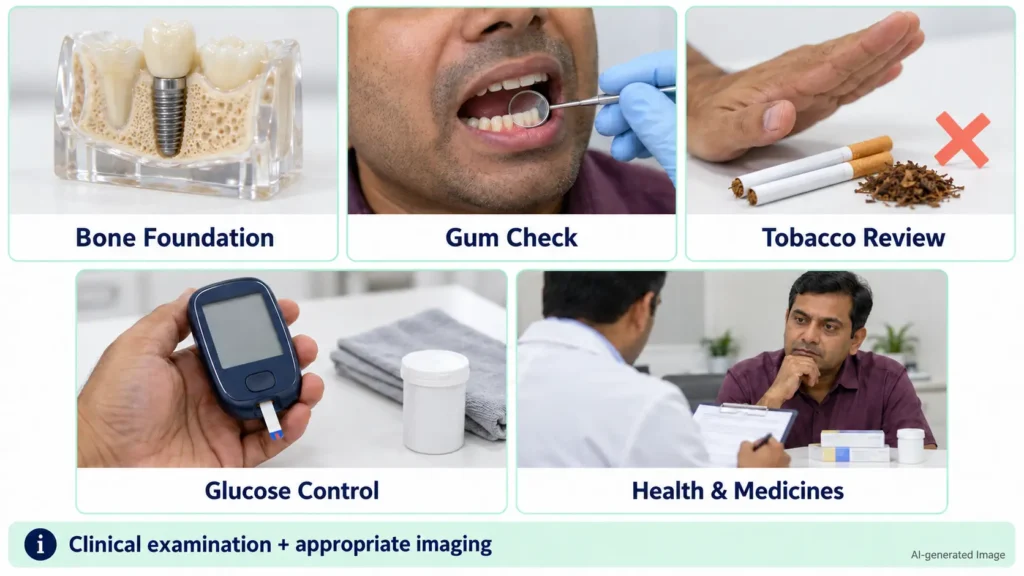
A dentist will assess:
- Bone quantity: The jaw must provide enough support. A bone graft may sometimes help when the bone is thin.
- Gum health: Active gum disease should be managed before implant treatment.
- Smoking: Tobacco can affect healing and long-term implant health.
- Diabetes: Well-managed diabetes may still allow treatment, while uncontrolled blood sugar requires attention first.
- Overall health: Medicines and conditions affecting healing must be reviewed.
The assessment usually includes a mouth examination and an X-ray or CT scan.
What Affects the Cost of Tooth Replacement?
The cost depends on the option selected and the treatment required. Dental implant cost in India varies because no single implant, crown, or clinical situation fits every patient.
Important factors include:
- the number and position of missing teeth;
- crown, bridge or denture material;
- implant system or brand;
- whether bone grafting is required; and
- the dentist’s training and experience.
Dentures generally cost less initially. Implants cost more upfront but may offer longer-term value because they often last longer. This is not guaranteed, as maintenance and oral health still matter.
Before choosing an option, have your gums, bone, and bite properly assessed. If you are considering a dental implant in Kolkata, a dental consultation can clarify whether an implant, bridge or denture is appropriate for your needs.
Frequently Asked Questions
What is the best way to replace a missing tooth?
There is no single best option. An implant often suits someone with healthy gums and enough bone, while a bridge or denture may suit another person better. The number of missing teeth, nearby teeth, health and budget guide the decision.
Is a dental implant better than a bridge?
Not always. An implant avoids reshaping neighbouring teeth and may last longer, but it needs surgery and sufficient bone. A bridge may be suitable when nearby teeth already need crowns or when an implant isn't advised.
How long do bridges, dentures and implants last?
A bridge may last about 5–15 years, while dentures often need replacement within 5–10 years. An implant post may last 15 years or longer, although its crown may need replacement sooner. Lifespan varies with care and oral health.
Is it possible to leave a missing tooth gap unfilled?
Sometimes, but only after a dental assessment. An untreated gap may allow teeth to shift, alter the bite or contribute to bone changes. Some back-tooth gaps can be monitored if chewing and bite stability are unaffected.
Is getting a bridge, denture or implant painful?
Treatment is usually manageable. Bridges and implants are placed using local anaesthetic, so pain should not be felt during the procedure. Dentures require no surgery but may cause temporary soreness while the mouth adjusts to their fit.