

Prostate Disorders Treatment in Kolkata
Home / Treatments / Urology / Prostate Disorders
Quick Answers
Are prostate disorders treatable?
Most prostate conditions respond to medicines, monitoring, procedures, or surgery.
Is surgery always required for prostate disorders?
Surgery depends on symptoms, cause, severity, and response to conservative treatment.
Can an enlarged prostate become serious?
Persistent enlargement may obstruct urine flow and cause kidney complications.
When should someone seek medical care?
Seek medical evaluation for persistent urinary symptoms, blood, pain, or retention.
What Are Prostate Disorders?
Disorders affecting the prostate gland involve this male reproductive organ located below the bladder and surrounding part of the urethra. Common examples include benign prostatic hyperplasia (BPH), prostatitis, and prostate cancer. Symptoms often involve changes in urination and may gradually become more noticeable.
Key points:
- Weak or interrupted urine flow may develop
- Starting urination can become difficult
- Frequent nighttime urination may occur
- A feeling of incomplete bladder emptying is possible
Types of Prostate Disorders
Benign Prostatic Hyperplasia (BPH)
Non-cancerous enlargement may obstruct urine flow and cause bothersome urinary symptoms.
Prostatitis
Inflammation may cause pelvic discomfort, painful urination, or other urinary symptoms.
Prostate Cancer
Abnormal prostate cells may grow silently, especially during early stages.
Symptoms of Prostate Disorders
Common Symptoms
- Slow or weak urine stream
- Frequent urination
- Sudden, urgent need to urinate
- Difficulty starting urination
- Leakage after urination
- Feeling the bladder remains full
Red Flags (Seek Immediate Medical Care)
- Complete inability to pass urine
- Blood in the urine
- Severe lower abdominal pain
- Fever and chills
- Painful urination with fever
- Severe urinary symptoms with infection signs
Why Choose Samaritan Medical Surgical & Critical Care?
At Samaritan Medical Surgical & Critical Care, we provide comprehensive healthcare solutions as per your needs. With a team of expert professionals, we focus on delivering compassionate, patient-centred care for optimal well-being.

NABH Certified
Accredited by NABH, ensuring the highest standards of healthcare quality and patient safety.

Surgical Excellence
Our skilled surgeons offer precision care for a wide range of surgical procedures.

Critical Care Support
Providing round-the-clock critical care with advanced equipment and expert medical teams.
Our Doctors
DR. AMLAN CHAKRABORTY
Qualifications: MBBS, MS, FRCS (Urology)
Specialty: Urology
Experience: 23 years
Fees: Rs. 1,700.00
Available Days: TUE,THURS & SAT(BY APPOINTMENT)
Available Time: 12:00 - 13:00 (BY APPOINTMENT)

DR. PRAMOD KUMAR SHARMA
Qualifications: MBBS,MS
Specialty: Urology
Experience: 21 years
Fees: Rs. 1,200.00
Available Days: BY APPOINTMENT
Available Time: By Appointment

DR. NILANJAN MITRA
Qualifications: MBBS, MS (Gen. Surg.), MCh (Urology)
Specialty: Urology
Experience: 19 years
Fees: Rs. 1,200.00
Available Days:TUE & THURS
Available Time: 8:30 - 10:30

DR. SMARANJIT CHATTERJEE
Qualifications: MBBS, MS, DNB, Mch
Specialty: Urology
Experience: 18 years
Fees: Rs. 1,200.00
Available Days: BY APPOINTMENT
Available Time: BY APPOINTMENT

DR. SOUVIK CHATTERJEE
Qualifications: MBBS, MS (Gen. Surg.), DNB, MCh (Urology)
Specialty: Urology
Experience: 16 years
Fees: Rs. 1,000.00
Available Days: WED, SAT
Available Time: WED: 15:00 - 16:00, SAT: 09:30 - 10:30

DR. SUBHOJIT MALAKAR
Qualifications: MBBS, MS (Gen. Surg.), DNB, MCh (Urology)
Specialty: Urology
Experience: 15 years
Fees: Rs. 1,000.00
Available Days: BY APPOINTMENT
Available Time: BY APPOINTMENT
DR. SUNIRMAL CHOWDHURY
Qualifications: MBBS, MS, IPGMER (HOD)
Specialty: Urology
Experience: 20 years
Fees: Rs. 1,200.00
Available Days: BY APPOINTMENT
Available Time: By Appointment
Hear From Our Happy Patients
Very good nursing home.all staff best
I had Laproscopic surgery of gallbladder stone on 23/6/26 & Discharge on 25/6/26. I had wonderful experience in nursing home, Very cooperative staff. Particularly Ms Aditi (Head Sister charge) , she has cooperated very well with Smily face. OT is well equipped with high quality instruments, Dr Mukesh Karia has done wonderful operations.
Very good nursing home
Very Supportive Staff with 24*7 support. Along with Neat and Clean cloths and bed.
Great treatment and recuperation. Doctors nurses and support staff mase it feel like home .
Thakuuuu Samaritan nursing home........and Dr.babuuuu khubbbb valooooo..apnader sakoler babohar khub valo r porisheba khubbb khubbb valo sakol k. Ank ank ank dhannobad ......
Very good nursing home
Very good Treatment here and also staff behaviour has very good
I have admitted my father here twice under Dr Arindam Dutta sir for the DJ stenting and RIRS (Kidney stone) .The entire team of Samaritan was fantastic.Specially Ms Aditi Nandi was so humble and cooperative .She attended us every time and Given all facilities.Through out the admitting time and discharge,all the sisters,brothers,Housekeeping ,ward boy everyone was so polite and well mannered.
Individuals at Highest Risk for Prostate Disorders
| Groups | Factors |
|---|---|
| Older Adults | Risk increases with age, especially after 50; BPH becomes increasingly common as you get older. |
| Family History | Having a father, brother, or multiple close relatives with prostate cancer increases risk. |
| Inherited Genetic Changes | BRCA1 or BRCA2 mutations can increase prostate cancer risk, particularly for more aggressive disease. |
| Urban Residents | Higher recorded incidence in some Indian cities may reflect lifestyle patterns and greater access to diagnosis. |
| Unhealthy Dietary Patterns | Low vegetable intake and higher consumption of processed or red meat may contribute to risk. |
| Metabolic Health Issues | Obesity and high blood pressure are associated with increased risk and more advanced disease. |
Causes Of Prostate Disorders
- Ageing and hormonal changes
- Family history and obesity
- Bacterial infections
- Pelvic nerve damage
- Chemical irritation from urine
- Previous urinary tract infections
- DNA changes in prostate cells
- Certain chemical exposures
Prostate Disorder Patterns, Diagnosis & Treatment Approach
| Pattern | Likely Condition | Initial Approach | Escalation | Outcome |
|---|---|---|---|---|
| Weak or slow flow | Enlargement or obstruction | Evaluation, medication | Persistent obstruction | Improved flow |
| Frequent urination, urgency | Lower urinary tract condition | Medical evaluation | Persistent symptoms | Better control |
| Night-time urination | Bladder or systemic cause | Cause-based assessment | Sleep disruption | Fewer episodes |
| Difficulty starting | Outlet obstruction | Evaluation, medication | Persistent obstruction | Easier urination |
| Urinary retention | Obstruction or bladder dysfunction | Urgent assessment, drainage | Recurrent retention | Restored emptying |
| Blood in urine | Urinary-tract condition | Prompt evaluation | Abnormal findings | Cause-dependent |
Procedures & Recovery Time: What to Expect
Prostate Biopsy
- Tissue samples are collected using needles
- Ultrasound guides the needle placement
- The area is numbed before the procedure
- The procedure takes about 15–20 minutes
Transurethral Resection of the Prostate (TURP)
- Excess prostate tissue is removed
- Specialised instruments pass through the urethra
- Blocking tissue is trimmed during surgery
- No external abdominal cuts are made
Radical Prostatectomy
- Entire prostate gland is surgically removed
- Surrounding lymph nodes may also be removed
- Open surgery uses larger abdominal incisions
- Robotic surgery uses smaller abdominal incisions
Recovery Timeline
- Biopsy recovery usually takes 1–2 days
- Biopsy symptoms may persist 2–4 weeks
- TURP recovery generally takes 3–6 weeks
- Prostatectomy recovery generally takes 6–8 weeks
Available Diagnosis & Tests
Physical Exams And Lab Tests
- Digital Rectal Exam (DRE)
- Prostate-Specific Antigen (PSA) Test
- Urinalysis
Imaging And Advanced Tests
- Ultrasound
- Urodynamic Studies
- Cystoscopy
- Prostate Biopsy
Available Treatment Options

Non-Surgical
- Lifestyle Changes
- Alpha-Blockers
- 5-Alpha Reductase Inhibitors
- Combination of alpha-blockers and 5-ARIs
- PDE5 Inhibitors
- Antibiotics
- Anti-Inflammatory Drugs
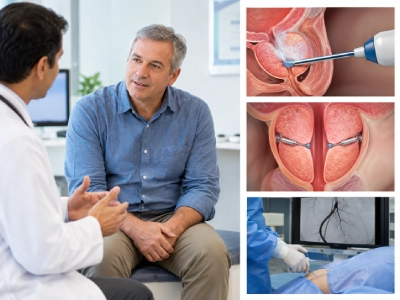
Minimally Invasive
- Rezūm Therapy
- UroLift
- PAE
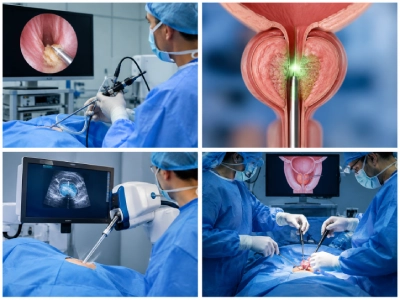
Surgical
- TURP
- Laser Therapy
- Aquablation
- Radical Prostatectomy
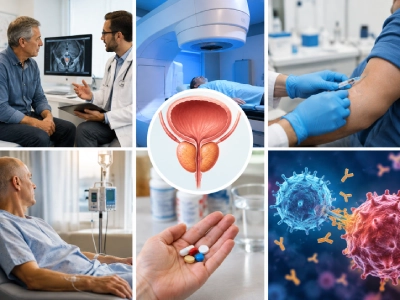
For Prostate Cancer
- Active Surveillance
- Radiation Therapy
- Hormone Therapy
- Chemotherapy
- Targeted Therapy
- Immunotherapy
Benefits of Prostate Disorder Treatment
- Stronger urine flow
- Fewer bathroom trips
- Complete bladder emptying
- Prevention of acute urinary retention
- Protection against bladder and kidney damage
- Reduced recurrent urinary tract infections
- Prevention of bladder stones
- Reduced pelvic pain
- More comfortable ejaculation
- Shrinking of enlarged prostate
- Control of prostate cancer progression
Complications if Left Untreated
- Acute or Chronic Urinary Retention
- Persistent Urinary Symptoms
- Recurrent Urinary Tract Infections
- Bladder Stones
- Bladder Muscle Damage
- Blood in the Urine
- Urinary Obstruction
- Hydronephrosis and Kidney Damage
- Progression of Underlying Prostate Disease
- Delayed Prostate Cancer Diagnosis
Daily Management & Prevention Tips
Management Tips
- Stay adequately hydrated throughout the day
- Limit fluids before going to bed
- Avoid caffeine, alcohol, and artificial sweeteners
- Practise double voiding after urination
- Review medications with your treating doctor
Prevention Tips
- Eat more lycopene-rich foods regularly
- Include cruciferous vegetables in meals
- Choose healthy fats over saturated fats
- Reduce red and processed meat intake
- Moderate consumption of high-fat dairy
- Maintain a healthy weight through diet
- Exercise regularly throughout the week
- Discuss appropriate prostate screening with doctors
Frequently Asked Questions
Can frequent urination at night always indicate a prostate problem?
Nighttime urination can have several causes, including prostate enlargement, bladder conditions, diabetes, fluid intake, sleep disorders, and certain medicines. Persistent symptoms require evaluation.
Can a weak urine stream mean the prostate is enlarged?
Enlargement can narrow the urethra and reduce urinary flow, although weak flow can also result from other urinary or neurological conditions.
Why do prostate symptoms often worsen gradually?
Prostate enlargement can progressively narrow the urinary passage, increasing resistance to urine flow and gradually producing more noticeable frequency, urgency, weak flow, or incomplete emptying.
Can prostate problems cause sudden urinary blockage?
Significant obstruction can result in acute urinary retention, causing an inability to urinate and requiring prompt medical assessment and treatment.
Do all prostate disorders cause noticeable symptoms?
Some conditions, particularly early prostate cancer, may produce few or no symptoms. Appropriate assessment is therefore important when clinical or individual risk factors warrant evaluation.