
Kidney Stone Treatment in Kolkata
Home / Treatments / Urology / Kidney Stone
Quick Answers
Can kidney stones be treated?
Treatment depends on stone size, type, location, symptoms, and whether complications develop.
Can kidney stones pass naturally?
Smaller stones may pass naturally with hydration, medicines, and appropriate medical monitoring.
Can kidney stones cause serious complications?
Untreated stones can cause urinary blockage, infections, persistent pain, and kidney damage.
When should someone seek medical care?
Seek urgent care for severe pain, fever, vomiting, blood in urine, or difficulty urinating.
What Are Kidney Stones?
Kidney stones are hard mineral deposits that form inside the kidneys when substances in urine become concentrated. They may remain in the kidney or move into the urinary tract, causing pain, blockage, or difficulty passing urine.
Key points:
- Urination may become painful
- Blood may appear in urine
- Dehydration increases stone formation risk
- Nausea may accompany severe episodes
Types of Kidney Stones
Calcium Stones
Calcium stones develop when calcium combines with oxalate or phosphate in urine.
Uric Acid Stones
Uric acid stones develop when persistently acidic urine promotes crystal formation.
Struvite Stones
Struvite stones develop when urinary infections create alkaline conditions for growth.
Cystine Stones
Cystine stones develop because inherited cystinuria causes excess cystine in urine.
Symptoms Of Kidney Stones
Common Symptoms
- Sharp back or side pain
- Pain radiating toward the groin or lower abdomen
- Pain occurring in waves
- Pain occurring in waves
- Blood in urine
Red Flags (When To See A Doctor)
- Severe or worsening pain
- Fever or chills
- Difficulty passing urine
- Persistent vomiting
- Severe weakness or dizziness
Why Choose Samaritan Medical Surgical & Critical Care?
At Samaritan Medical Surgical & Critical Care, we provide comprehensive healthcare solutions as per your needs. With a team of expert professionals, we focus on delivering compassionate, patient-centred care for optimal well-being.

NABH Certified
Accredited by NABH, ensuring the highest standards of healthcare quality and patient safety.

Surgical Excellence
Our skilled surgeons offer precision care for a wide range of surgical procedures.

Critical Care Support
Providing round-the-clock critical care with advanced equipment and expert medical teams.
Our Doctors
DR. AMLAN CHAKRABORTY
Qualifications: MBBS, MS, FRCS (Urology)
Specialty: Urology
Experience: 23 years
Fees: Rs. 1,700.00
Available Days: TUE,THURS & SAT(BY APPOINTMENT)
Available Time: 12:00 - 13:00 (BY APPOINTMENT)

DR. PRAMOD KUMAR SHARMA
Qualifications: MBBS,MS
Specialty: Urology
Experience: 21 years
Fees: Rs. 1,200.00
Available Days: BY APPOINTMENT
Available Time: By Appointment

DR. NILANJAN MITRA
Qualifications: MBBS, MS (Gen. Surg.), MCh (Urology)
Specialty: Urology
Experience: 19 years
Fees: Rs. 1,200.00
Available Days:TUE & THURS
Available Time: 8:30 - 10:30

DR. SMARANJIT CHATTERJEE
Qualifications: MBBS, MS, DNB, Mch
Specialty: Urology
Experience: 18 years
Fees: Rs. 1,200.00
Available Days: BY APPOINTMENT
Available Time: BY APPOINTMENT
DR. SOUVIK CHATTERJEE
Qualifications: MBBS, MS (Gen. Surg.), DNB, MCh (Urology)
Specialty: Urology
Experience: 16 years
Fees: Rs. 1,000.00
Available Days: WED, SAT
Available Time: WED: 15:00 - 16:00, SAT: 09:30 - 10:30

DR. SUBHOJIT MALAKAR
Qualifications: MBBS, MS (Gen. Surg.), DNB, MCh (Urology)
Specialty: Urology
Experience: 15 years
Fees: Rs. 1,000.00
Available Days: BY APPOINTMENT
Available Time: BY APPOINTMENT
DR. SUNIRMAL CHOWDHURY
Qualifications: MBBS, MS, IPGMER (HOD)
Specialty: Urology
Experience: 20 years
Fees: Rs. 1,200.00
Available Days: BY APPOINTMENT
Available Time: By Appointment
Hear From Our Happy Patients
Very good nursing home.all staff best
I had Laproscopic surgery of gallbladder stone on 23/6/26 & Discharge on 25/6/26. I had wonderful experience in nursing home, Very cooperative staff. Particularly Ms Aditi (Head Sister charge) , she has cooperated very well with Smily face. OT is well equipped with high quality instruments, Dr Mukesh Karia has done wonderful operations.
Very good nursing home
Very Supportive Staff with 24*7 support. Along with Neat and Clean cloths and bed.
Great treatment and recuperation. Doctors nurses and support staff mase it feel like home .
Thakuuuu Samaritan nursing home........and Dr.babuuuu khubbbb valooooo..apnader sakoler babohar khub valo r porisheba khubbb khubbb valo sakol k. Ank ank ank dhannobad ......
Very good nursing home
Very good Treatment here and also staff behaviour has very good
I have admitted my father here twice under Dr Arindam Dutta sir for the DJ stenting and RIRS (Kidney stone) .The entire team of Samaritan was fantastic.Specially Ms Aditi Nandi was so humble and cooperative .She attended us every time and Given all facilities.Through out the admitting time and discharge,all the sisters,brothers,Housekeeping ,ward boy everyone was so polite and well mannered.
Individuals at Highest Risk for Kidney Stones
| Groups | Factors |
|---|---|
| Personal History | Previous kidney stones |
| Family History | Parent or sibling with kidney stones |
| Age & Sext | Men; adults aged 30–60 |
| Hydration & Climate | Dehydration; hot, dry climate; heavy sweating |
| Diet | High sodium, added sugars or excessive animal protein |
| Weight | Obesity |
| Metabolic Conditions | Diabetes; insulin resistance; gout |
| Digestive Conditions | IBD; Crohn’s disease; gastric bypass |
| Urinary Conditions | Recurrent urinary tract infections |
Causes Of Kidney Stones
- Not drinking enough water
- Too much salt or protein
- Excess oxalate-rich foods
- Certain health conditions
- Family history
- Reduced natural urine protection
Kidney Stone Patterns, Diagnosis & Treatment Approach
| Pattern | Type | First-Line Approach |
When Advanced Treatment Is Needed |
Expected Outcome |
|---|---|---|---|---|
| Less than 4 mm | Small stone | Hydration and medication | Failure to pass naturally | Likely natural passage |
| 4–6 mm | Moderate stone | Medication or observation | Persistent stone or symptoms | Possible assisted passage |
| 6–10 mm | Larger stone | Urological evaluation | Unlikely natural passage | Removal with appropriate procedure |
| More than 10 mm | Large stone | Specialist intervention | Significant obstruction or complexity | Procedural stone clearance |
Procedure & Recovery: What to Expect
Non-invasive (Shock Wave Lithotripsy (ESWL))
- Stone fragments may pass through urine afterwards.
- Mild discomfort may occur after treatment.
- Blood in urine may occur temporarily.
- Follow-up imaging may be used to check for remaining fragments.
Scope-based (Ureteroscopy (URS) / RIRS)
- Mild burning during urination may occur.
- Blood in urine may occur temporarily.
- A stent may cause urinary urgency.
- Small stone fragments may pass afterwards.
Minimally invasive (Percutaneous Nephrolithotomy (PCNL))
- Mild pain around the incision may occur.
- A temporary drainage tube may be used.
- Blood in urine may occur after treatment.
- Follow-up imaging may assess stone clearance.
Recovery Timeline
- ESWL: Recovery usually takes 1–2 days.
- URS/RIRS: Recovery generally takes 2–3 days.
- PCNL: Recovery usually takes 1–2 weeks.
- Hospital stay: 1–3 days.
Available Diagnosis & Tests
Imaging Tests
- CT Scan (Computed Tomography)
- Ultrasound
- Abdominal X-ray (KUB)
Laboratory Tests
- Urinalysis
- 24-Hour Urine Collection
- Blood Tests
- Stone Analysis
Available Treatment Options
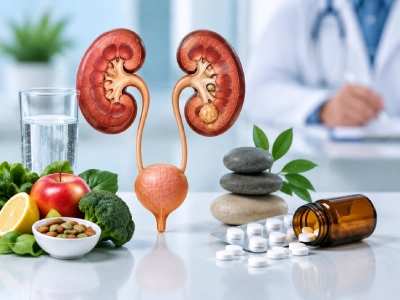
Non-Surgical
- Alpha-blockers
- Hydration Therapy
- Pain Management
- Medical Expulsive Therapy (MET)
- Dietary & Lifestyle Modifications
- Oral Dissolution Therapy
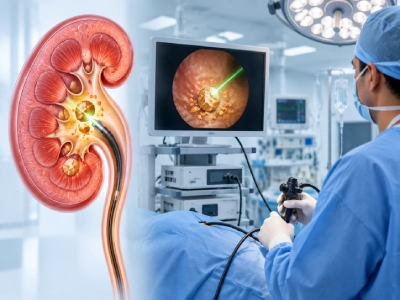
Laser Treatment
- Ureteroscopy/Retrograde Intrarenal Surgery (URS/RIRS)
- Laser Lithotripsy
- Stone Fragment Removal
- No External Incision
- Small-to-Medium Stone Treatment
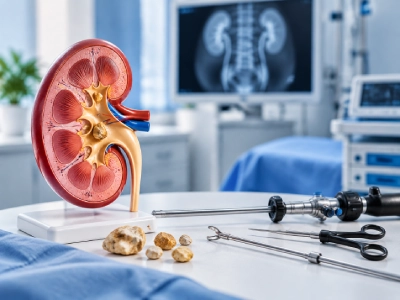
Surgical
- Extracorporeal Shock Wave Lithotripsy (ESWL)
- Open or Laparoscopic
- Retrograde Intrarenal Surgery (RIRS)
- Percutaneous Nephrolithotomy (PCNL)
- Double J Stenting
Benefits of Kidney Stone Treatment
- Reduced pain and discomfort
- Faster recovery than traditional surgery
- Shorter hospital stays after treatment
- High success rates for stone removal
- Minimal scarring after minimally invasive procedures
Complications if Left Untreated
- Persistent or worsening pain
- Urinary tract infections
- Blockage of urine flow
- Hydronephrosis (Kidney Swelling)
- Sepsis
- Kidney damage and failure
- Increased risk of recurrence
Daily Management & Prevention Tips
Management Tips
- Drink 2.5–3 litres daily.
- Reduce excess salt intake
- Limit high-oxalate foods.
- Balance dietary calcium.
- Avoid excess animal protein.
- Maintain consistent hydration.
Prevention Tips
- Maintain a healthy weight.
- Stay physically active.
- Drink fluids consistently.
- Follow personalised dietary advice.
- Complete recommended metabolic evaluation.
- Attend follow-up appointments.
Frequently Asked Questions
Why do kidney stones cause nausea and vomiting?
When a blockage stretches the kidney, shared nerve pathways between the urinary and digestive systems can trigger nausea, vomiting, and other stomach-related symptoms.
Why is a 24-hour urine test done after stones?
It measures daily levels of calcium, oxalate, uric acid, citrate, sodium, and urine volume to identify metabolic factors that may contribute to future formation.
Can untreated kidney stones cause permanent kidney damage?
A prolonged blockage can cause urine buildup, kidney swelling, tissue damage, and gradual loss of function, sometimes occurring without severe symptoms.
Can low calcium intake increase kidney stone risk?
Adequate dietary calcium binds oxalates in the intestine, reducing their absorption. Too little calcium leaves more available to reach the kidneys and form crystals.
Why is urine pH important for kidney stone prevention?
Urine acidity affects which substances crystallise. Highly acidic urine promotes uric acid formation, while excessive alkalinity can favour calcium phosphate crystallisation.