
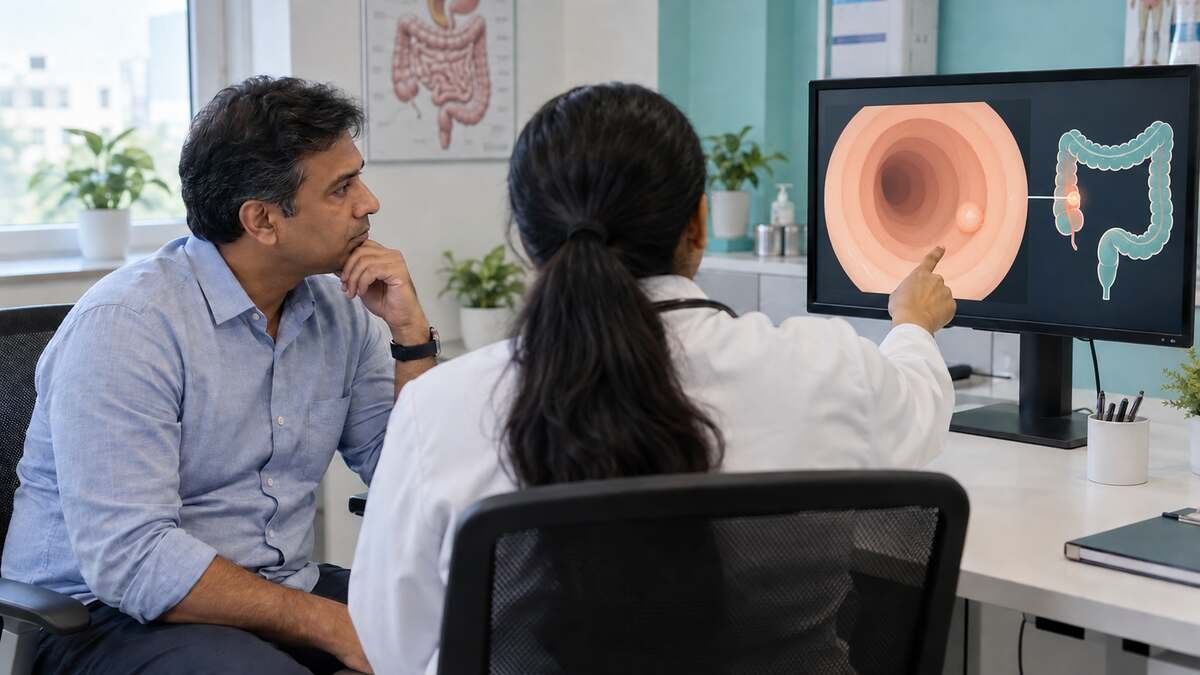
Blood in the stool can be alarming, but visible bleeding is not the only reason to examine the colon. A blood-in-stool test may start the investigation, but it can't show where the blood came from or what the bowel lining looks like.
Colonoscopy stands apart because it can inspect the entire colon, collect tissue and remove suitable polyps during the same visit. Other tests provide useful clues but do not offer this full combination.
This guide explains:
- what a colonoscopy can detect and treat;
- how it compares with stool tests and scans; and
- when screening or diagnostic colonoscopy may be advised.
What is a Colonoscopy and How Does It Work?
A colonoscopy uses a flexible tube with a camera to examine the rectum and large intestine. Bowel-cleansing medicine empties the colon beforehand, while sedation or pain-relieving medicine is commonly used for comfort.
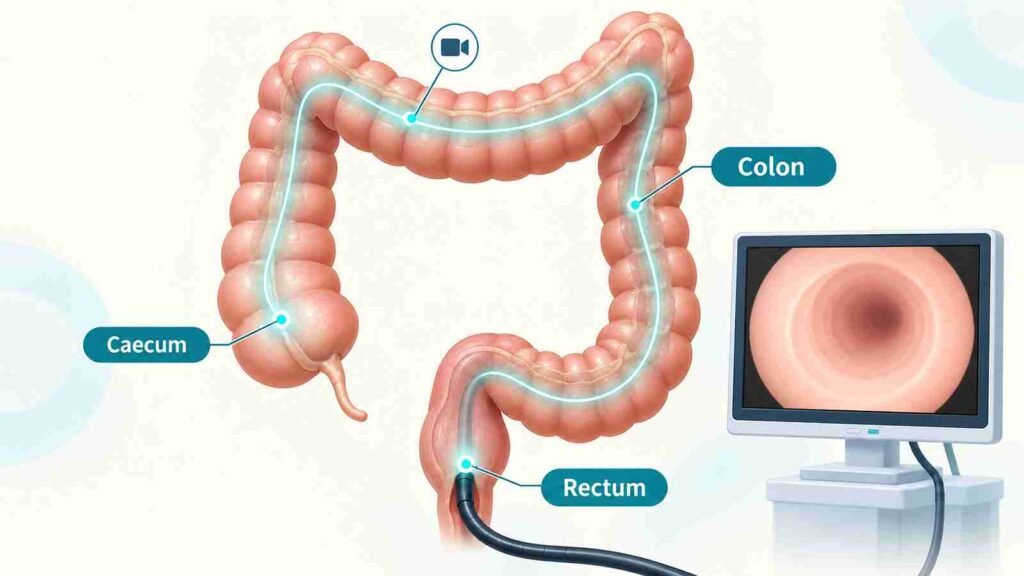
During the colonoscopy procedure, the scope passes gently through the anus and sends images to a monitor. Instruments can pass through it to collect a biopsy, control certain bleeding points or remove a polyp.
What the Doctor Can See During a Colonoscopy?
A complete examination covers:
- the rectum;
- sigmoid and descending colon;
- transverse colon;
- ascending colon; and
- caecum, where the large intestine begins.
Direct viewing can reveal polyps, ulcers, inflammation, tumours, diverticula and possible bleeding points. Proper bowel preparation matters because retained stool can hide abnormalities and reduce colorectal polyp detection.
Can the Doctor Treat a Problem During the Same Procedure?
Yes. A suitable polyp can be removed using a wire loop, forceps, or another device passed through the scope. This is called polypectomy. The tissue is sent to a laboratory for examination.
This ability to perform precancerous polyp removal during colonoscopy is a key advantage. A scan or stool test cannot take a biopsy or remove a growth. Large or complex polyps may still require advanced endoscopy or surgery.
What Conditions Can a Colonoscopy Detect that Other Tests Miss?
Colonoscopy can identify subtle changes in the mucosa—the colon’s inner lining. These changes may not cause symptoms, release blood or appear clearly on routine scans.
Colorectal Cancer and Precancerous Polyps
Many colorectal cancers begin as polyps. Most polyps are not cancerous, but some types may change over time. Early polyps can be silent and may not bleed consistently.
For colon cancer screening, the procedure enables direct inspection, biopsy and colorectal polyp detection. Suitable polyps can be removed before they progress. CT colonography can identify some polyps, but it cannot remove them.
Colonoscopy is not perfect. Accuracy depends on bowel preparation, completion of the examination and the endoscopist’s technique.
Inflammatory Bowel Disease (IBD) — Crohn’s and Ulcerative Colitis
Crohn’s disease and ulcerative colitis may cause diarrhoea, bleeding, abdominal pain, urgency and weight loss. Blood tests, stool tests and scans may suggest inflammation.
Colonoscopy for IBD diagnosis allows the specialist to view inflammation and ulcers, map their distribution and collect biopsies. However, it may be postponed or limited during severe acute inflammation for safety.
Unexplained Rectal Bleeding and Its Source
A stool test can detect possible blood but cannot locate its origin. Colonoscopy may identify a polyp, inflamed area, diverticulum, vascular change or tumour.
This makes it valuable in a blood in stool investigation. Piles and anal fissures may also require a separate examination because not every bleeding source is deeper inside the colon.
Colonoscopy vs Other Tests — What Sets It Apart?
Each test answers a different question.
| Test | What It Shows | Biopsy or Polyp Removal | Main Limitation |
| Colonoscopy | Direct view of the colon lining | Yes | Requires bowel preparation and has small procedural risks |
| FIT or FOBT | Hidden blood in stool | No | Cannot locate bleeding or detect every non-bleeding lesion |
| CT colonography | Computer-generated colon images | No | Uses radiation and may require follow-up colonoscopy |
| Ultrasound | Abdominal organs and surrounding structures | No | Does not directly inspect the colon lining |
| MRI | Bowel wall and nearby tissues with specialised methods | No | Cannot remove polyps or take an endoscopic biopsy |
Colonoscopy vs Stool Test (FOBT/FIT)
In the colonoscopy vs stool test comparison, FIT and FOBT are convenient, non-invasive screening tools. They look for hidden blood rather than viewing the bowel.
A positive result can have a non-cancerous cause, while a non-bleeding lesion may produce a negative result. As per the American Cancer Society, a positive stool-based screening test requires timely colonoscopy to locate the cause.
Colonoscopy vs CT Colonography
CT colonography, or virtual colonoscopy, creates images using X-rays. It can detect some polyps and cancers but still requires bowel preparation and involves radiation. If it finds an abnormality, a conventional procedure may be needed for biopsy or removal. NIDDK confirms that virtual colonoscopy cannot remove polyps.
The main endoscopy and colonoscopy difference is the area examined. Upper GI endoscopy enters through the mouth to inspect the oesophagus, stomach and duodenum. Colonoscopy enters through the anus to inspect the rectum and colon. Both are endoscopic procedures.
Colonoscopy vs Ultrasound and MRI
Ultrasound does not directly display the inner colon lining. Standard MRI also cannot replace colonoscopy for mucosal inspection or biopsy.
Specialised MRI can help diagnose bowel disease, particularly Crohn’s disease affecting the small bowel or surrounding tissue. It complements colonoscopy rather than replacing it.
A gastroenterology specialist in Kolkata or another location can decide which test or combination best matches the symptoms.
Who Should Get a Colonoscopy Test?
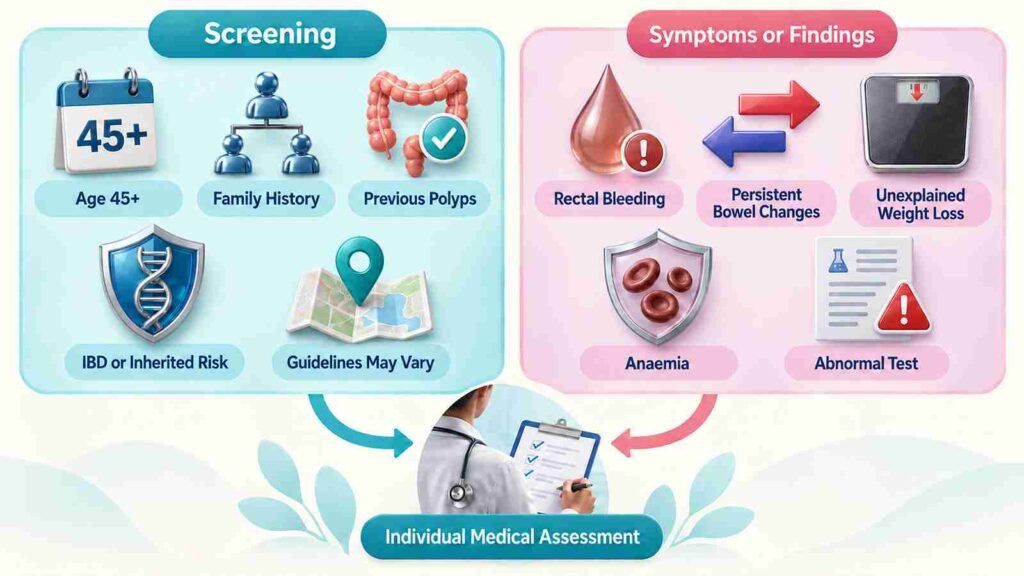
This procedure may be used for screening without symptoms or to investigate a concern. Age, symptoms, family history, previous polyps and general health guide the decision.
Screening Recommendations — Age and Risk Factors
The American Cancer Society recommends regular colon cancer screening from age 45 for average-risk adults. Recommendations vary by country, so local medical advice matters.
Earlier or more frequent assessment may be advised for people with:
- a close relative with colorectal cancer or advanced polyps;
- previous colorectal polyps or cancer;
- long-standing inflammatory bowel disease;
- an inherited colorectal cancer syndrome; or
- previous radiation to the abdomen or pelvis.
It is not the only screening option. FIT may suit some average-risk adults when completed at the recommended interval.
Symptoms that Warrant an Immediate Colonoscopy
A doctor may consider colonoscopy for bowel disease diagnosis following:
- unexplained rectal bleeding;
- a persistent change in bowel habits;
- ongoing abdominal pain;
- unexplained weight loss;
- iron-deficiency anaemia without a known cause; or
- an abnormal stool test or scan.
These signs do not automatically mean cancer, but they require timely assessment. Colonoscopy may not be the first or safest test in every case.
Colonoscopy is More than a Diagnostic Test
Colonoscopy can screen for early disease, inspect the entire colon lining, locate bleeding, take biopsies and remove suitable polyps. No stool test or scan provides the same combination.
At Samaritan Medical Surgical & Critical Care, we assess bowel symptoms and recommend tests based on age, risk, and clinical findings. To discuss a colonoscopy test in Kolkata, contact us at 9836292167.
What People Also Ask
Is a colonoscopy painful or uncomfortable?
Sedation and pain-relieving medicine usually reduce discomfort. Some people feel pressure, bloating or cramps. The bowel preparation is often the least comfortable part.
Can a colonoscopy detect cancer in its early stages?
Yes. It can reveal small cancers and precancerous polyps before symptoms develop. A biopsy confirms whether abnormal tissue is cancerous.
How is a colonoscopy different from an endoscopy?
Upper GI endoscopy examines the oesophagus, stomach and duodenum through the mouth. Colonoscopy examines the rectum and colon through the anus.
How often is colonoscopy needed after a normal result?
For an average-risk adult with a high-quality normal screening, many guidelines use a ten-year interval. Family history, symptoms, preparation quality and previous findings may change the schedule.
Is a stool test enough, or is colonoscopy also needed?
A stool test may suit some people when repeated as advised. A positive result requires follow-up colonoscopy. Symptoms or higher risk may also make the technique preferable.