

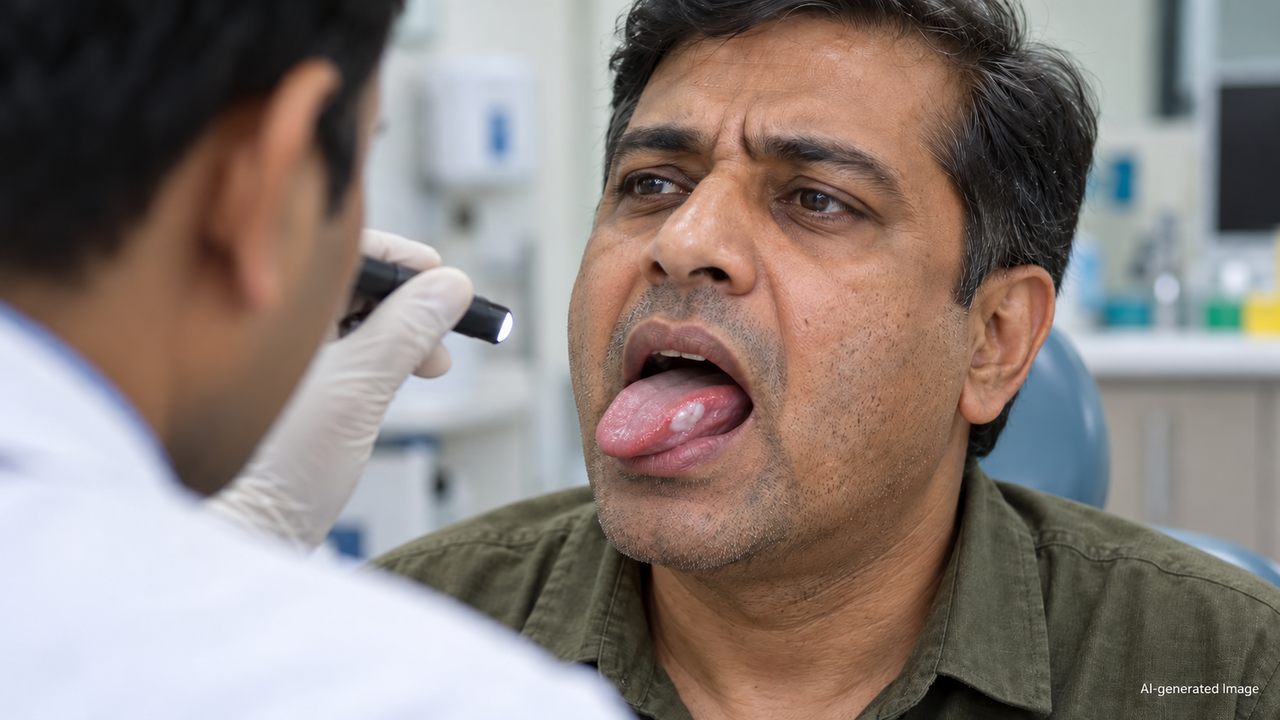
Oral cancer begins when abnormal cells grow in the lips or the lining of the mouth, including the tongue, cheeks, gums and palate. But many early signs of oral cancer look like everyday mouth problems: an ulcer, a sore tongue, a rough patch or a loose tooth. Because they are often painless and usually harmless, many people wait for them to settle.
That delay matters. Indian studies and cancer registry data suggest that around 60-70%1 of oral cancers are diagnosed at an advanced stage, when treatment is more complex. However, most mouth problems are not cancer, but a change that lasts beyond two to three weeks deserves an examination. So, in this guide, we’ve covered the 10 early signs of oral cancer that are often ignored, who may have a higher risk, including people who smoke, chew tobacco or paan, or drink alcohol and what to do when a symptom does not go away.
Early Signs of Oral Cancer: 10 Symptoms You Shouldn’t Ignore
Delayed diagnosis may allow oral cancer to spread. Five-year relative survival is 72%–88%2 (approx.) for selected localised oral and throat cancers, compared with 22%–40%3 (approx.) for a disease that has spread to distant organs.
As a result, early signs of oral cancer need to be detected in time. However, these mouth cancer symptoms affecting any part of your mouth might not always mean malignancy.
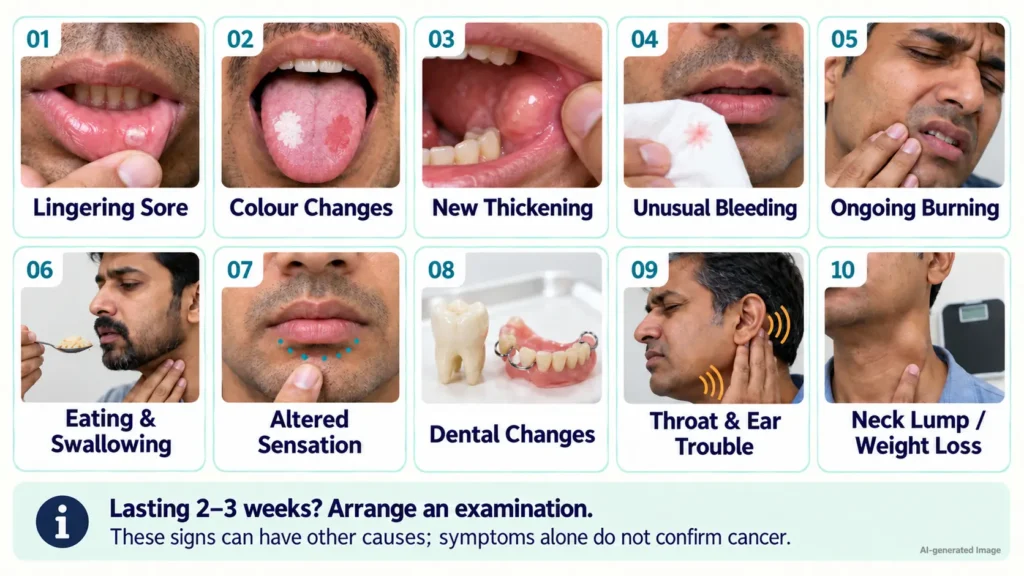
1. A Mouth Ulcer That Won’t Heal
A mouth ulcer that won’t heal within 2-3 weeks needs assessment. Minor ulcers often hurt and improve within one or two weeks. A concerning ulcer may have a firm edge, bleed repeatedly or remain painless at first. Pain alone cannot confirm or rule out cancer.
2. White or Red Patches Inside the Mouth
White patches in the mouth (leukoplakia) usually cannot be wiped or scraped away. Red patches in the mouth (erythroplakia) appear as persistent red areas without a clear cause.
These patches are not always cancerous. However, some may contain abnormal cells, so a doctor or dentist should examine them.
3. A Lump, Thickening or Rough Area
A hard swelling or thickened area may appear on the tongue, cheek, lip or gums. A lump in the mouth or neck may develop during an infection, but it should reduce as the infection settles.
Arrange an examination if the lump grows, feels firm or remains for 2-3 weeks.
4. Unexplained Bleeding in the Mouth
Bleeding may follow hard brushing, a mouth injury or gum disease. It becomes more concerning when it occurs repeatedly without a clear reason.
Notice where the bleeding starts and whether there is an ulcer, patch or lump nearby. Seek advice if it continues.
5. Persistent Mouth Pain or Burning With Spicy Food
Ongoing pain or burning while eating spicy food can result from an ulcer, infection or another oral condition. Seek attention if the same area stays sensitive for 2-3 weeks.
A dentist can check whether a tooth, denture or damaged tissue is causing the discomfort.
6. Difficulty Chewing, Swallowing or Moving the Tongue
Persistent difficulty swallowing may feel as though food is catching in the throat. Some people also notice pain while swallowing, restricted tongue movement or jaw stiffness.
A new problem affecting eating, speaking or tongue movement should be examined if it lasts for 2-3 weeks.
7. Numbness in the Mouth, Lip or Tongue
A numb or tingling area can develop after dental treatment or an injury. Persistent numbness without an obvious explanation needs attention.
Check whether it appears with an ulcer, swelling or colour change. Tell the doctor when it began and whether it is worsening.
8. Loose Teeth, Ill-Fitting Dentures or a Socket That Won’t Heal
Teeth can loosen because of gum disease or injury. However, unexplained loosening requires investigation. Dentures that suddenly become uncomfortable may also indicate swelling or a change in the gums.
An extraction site that remains painful, swollen or unhealed beyond the expected recovery period should be reviewed.
9. Persistent Sore Throat, Hoarse Voice or Ear Pain
A sore throat, voice change or one-sided ear pain can accompany an infection. Seek assessment if no ear problem is found, or if the symptom lasts 2-3 weeks.
A persistent feeling that something is caught in the throat also deserves attention.
10. Swollen Neck Glands or Unexplained Weight Loss
A painless neck lump may be an enlarged lymph node caused by infection. See a doctor if it grows, feels hard, or lasts 2-3 weeks.
Unplanned weight loss, particularly with swallowing problems or other oral cancer symptoms, also requires medical review.
If any of these signs last for 2-3 weeks, arrange an examination rather than continuing home treatment.
Who Is at Higher Risk of Oral Cancer?
The main oral cancer risk factors include tobacco, areca nut and heavy alcohol use. Risk may increase with the amount used and the length of exposure.
Important factors include:
- smoking cigarettes or bidis;
- chewing tobacco, khaini or gutkha;
- chewing areca nut or paan, even without tobacco;
- heavy alcohol use, particularly alongside tobacco;
- persistent high-risk HPV infection, mainly for cancers near the tonsils and base of the tongue;
- age above 40; and
- a previous head or neck cancer.
A sharp tooth or poorly fitting denture can repeatedly injure the mouth. Such irritation needs correction, although it is not as firmly established as tobacco, areca nut or alcohol as a direct cancer risk.
Oral cancer can also affect younger adults and people who have never used tobacco.
What to Do if You Notice These Signs
Do not try to identify the cause by appearance alone. A dentist, oral and maxillofacial surgeon, or head-and-neck specialist can examine the mouth and neck.
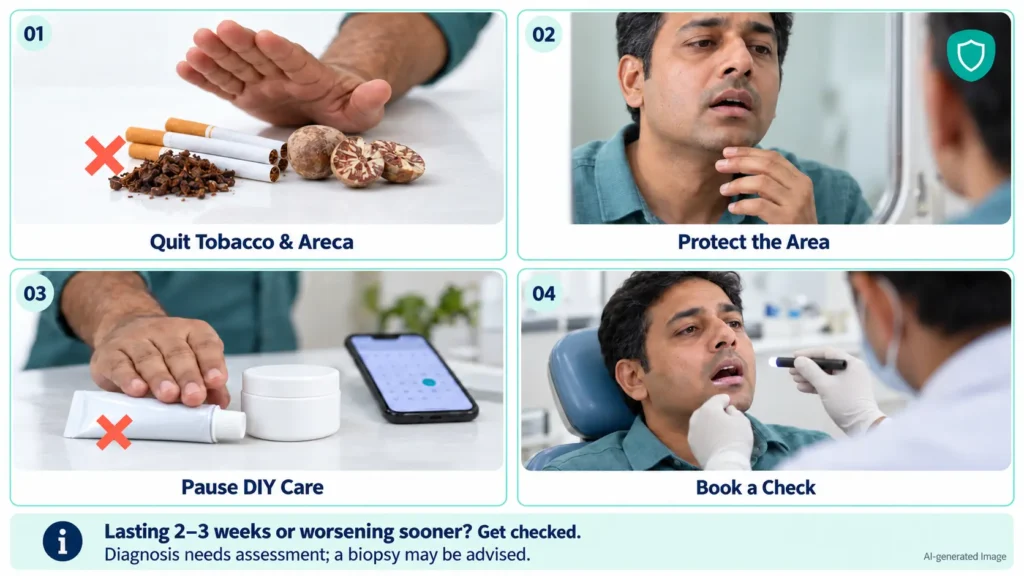
Take these steps:
- Stop tobacco and areca-nut products: Avoid cigarettes, bidis, gutkha, khaini and paan.
- Prevent further irritation: Do not pick, rub or apply harsh substances to the affected area.
- Avoid prolonged self-treatment: Gels and home remedies may reduce discomfort without treating the cause.
- Arrange an examination: Seek advice when a change lasts for 2-3 weeks or worsens sooner.
An oral cancer diagnosis cannot be confirmed by appearance alone. If an area looks suspicious, the doctor may recommend a biopsy—removing a small tissue sample and examining it in a laboratory.
Oral Cancer Treatment: Why Early Detection Matters
Early-detected oral cancer is generally easier to treat. Early assessment may allow less extensive treatment and a shorter recovery than when the disease has advanced.
Treatment depends on the affected area, test findings and overall health. It may include:
- surgery to remove the affected tissue;
- radiation therapy;
- chemotherapy, sometimes with radiation; or
- a combination planned by a head-and-neck cancer team.
These treatments are not recommended simply because symptoms are present. Tests must first confirm the diagnosis, and the care plan is then personalised.
Don’t Delay! Take Your Next Step Now
If an ulcer, patch, lump or swallowing problem lasts for 2-3 weeks, arrange an assessment rather than waiting longer. We can examine suspicious mouth changes and guide the next diagnostic steps. Call now to book a consultation for oral cancer treatment in Kolkata.
Frequently Asked Questions
What does early-stage oral cancer look like?
It may look like a persistent ulcer, white or red patch, thickened area or small lump. However, harmless conditions can look similar. Any unexplained mouth change lasting 2-3 weeks should be professionally examined.
Is a mouth ulcer that doesn’t heal always cancer?
No. Infection, accidental biting, dental irritation and other conditions can delay healing. However, an ulcer that remains for 2-3 weeks, enlarges, becomes firm or repeatedly bleeds needs an assessment.
How long should I wait before seeing a doctor for a mouth sore?
Arrange an examination if the sore remains for 2-3 weeks. Seek help sooner if it grows quickly, repeatedly bleeds, affects swallowing or appears with facial swelling or a persistent neck lump.
Is oral cancer painful in the early stage?
Not always. An early lesion may be painless, mildly sore or sensitive to spicy food. Pain cannot confirm or rule out oral cancer. A persistent visible or sensory change is a stronger reason to arrange an examination.
Can oral cancer be cured if detected early?
Early oral cancer can often be treated successfully, but no outcome can be guaranteed. The outlook depends on its location, size, spread, overall health and response to treatment. Prompt diagnosis generally provides more treatment options.