
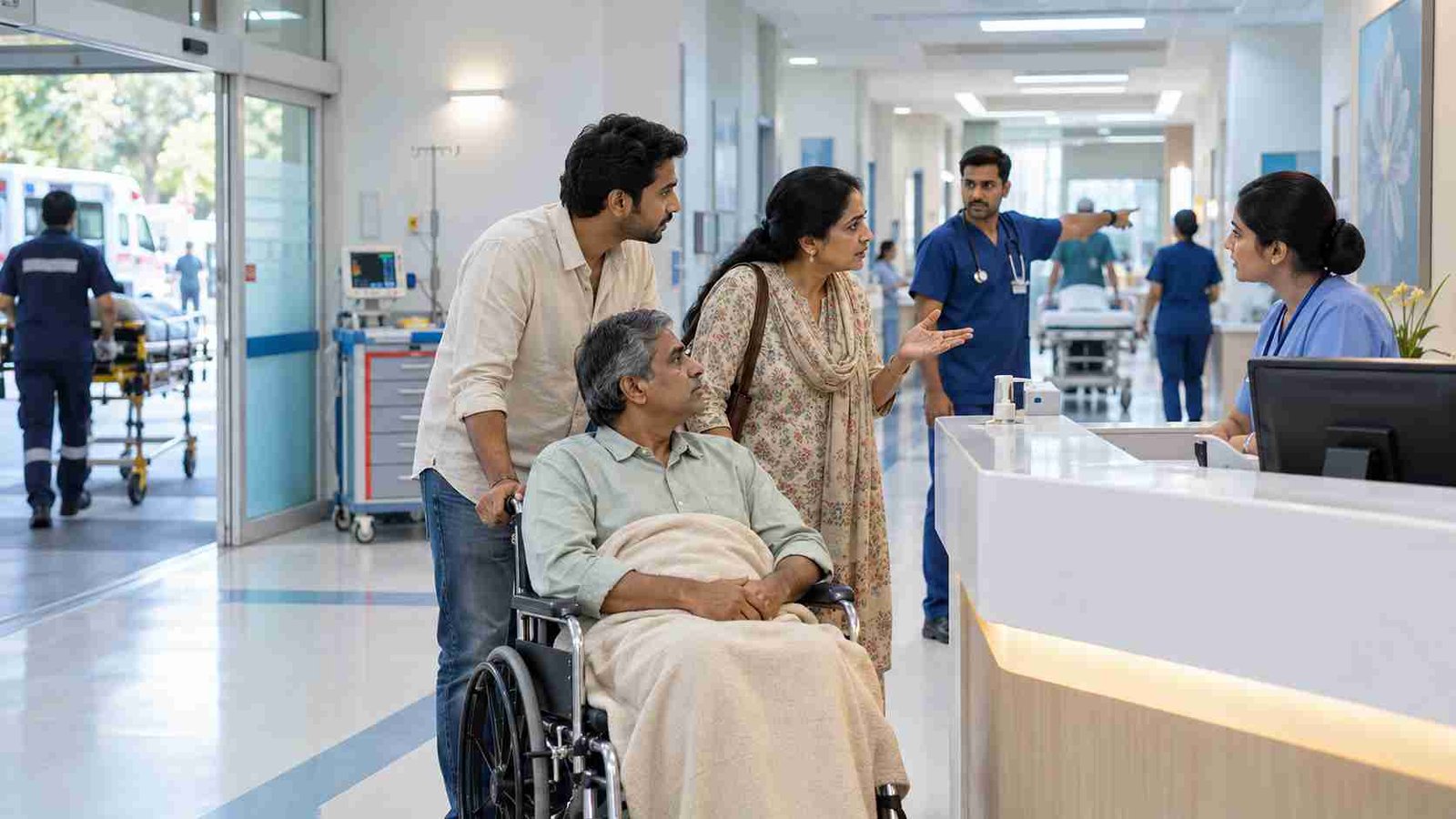
In India, national clinical registries indexed by the National Library of Medicine show that, on average, 13,500 to 14,000 people are admitted to a critical care unit every day. For most, a medical emergency leaves little time to compare options. When someone has crushing chest pain, becomes unresponsive, or struggles to breathe, any random clinic may not have the staff or equipment needed to stabilise them.
Families searching for an emergency hospital should examine readiness, not reputation alone. So, this blog covers the following aspects to help you prepare better in such situations:
- Signs that need immediate critical care
- Facilities and specialists worth checking
- Steps families can take before any urgent medical attention is needed
Why the First 60 Minutes Matter in a Medical Emergency
The “golden hour” reminds us that delays can reduce treatment options, although not every emergency follows an exact 60-minute rule. Cardiac arrest, heart attack, stroke, major bleeding, sepsis and severe breathing difficulty are time-sensitive conditions. Early assessment and treatment can limit damage to vital organs.
The World Health Organization describes emergency care as time-sensitive care for acute illness and injury. Effective life-threatening emergency treatment begins with triage, followed by assessment of the airway, breathing and circulation. Tests and treatment should then follow without avoidable delay.
Speed is only useful when the hospital is prepared. Trained teams, resuscitation equipment, diagnostics and a clear path to the ICU, ICCU or operating theatre all matter.
What are the Signs When You Need Immediate Critical Care?
Critical illness is not always dramatic. Recognising the following warning signs can help families act before the patient’s condition worsens.
Cardiac and Breathing Emergencies
Call an ambulance for chest pressure or squeezing, pain spreading to the arm or jaw, severe breathlessness, blue or grey lips, fainting, or an irregular heartbeat with weakness. Someone who is unresponsive and not breathing normally needs urgent help and CPR from a trained person.
Do not let the patient drive. Ambulance staff can begin assessment during transport and alert the receiving team. Heart attack guidance also recommends calling an ambulance for these warning signs.
Severe Trauma and Accidents
Heavy bleeding, head injury, deep wounds, major burns, a crushed limb, suspected spinal injury or loss of consciousness after an accident requires immediate care. Avoid moving someone with a possible neck or back injury unless there is an immediate danger.
Appropriate emergency room facilities should support airway care, bleeding control, imaging, blood support and rapid access to surgery or intensive monitoring.
Sudden Neurological Symptoms
Facial drooping, one-sided weakness, slurred speech, sudden confusion, loss of balance or a severe unexplained headache may signal a stroke. A prolonged seizure, repeated seizures or failure to regain consciousness also requires urgent care.
Note when the person was last known to be well. This information can affect which stroke treatments are possible.
What are the Factors to Consider When Choosing a Critical Care Hospital in Kolkata?
During an immediate crisis, seek professional emergency help without spending time comparing websites. When planning, check whether the hospital can stabilise the patient and provide further care under one roof.
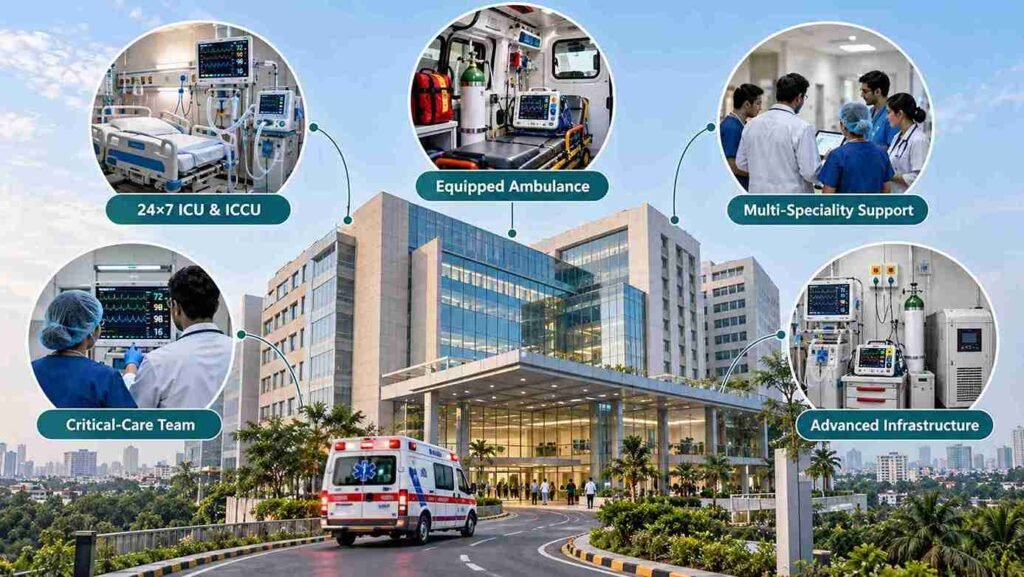
24×7 ICU and ICCU Availability
An ICU treats critically ill patients who need constant monitoring, ventilation, blood-pressure support or other forms of organ support. An ICCU focuses mainly on serious cardiac conditions.
A dependable ICU hospital needs genuine round-the-clock ICU support, including doctors, nurses, technicians, beds and essential equipment at night and on holidays. Ask how urgent admissions are handled and what happens when no critical-care bed is available.
Ambulance Response Time
An ambulance should suit the patient’s condition, not merely serve as transport. It may carry oxygen, suction, monitors, emergency medicines and trained personnel.
An ICCU ambulance can support a cardiac patient or anyone requiring close monitoring during transfer. Check the service area, expected response time and whether the ambulance team contacts the hospital before arrival.
Availability of Multi-Speciality Support
An accident may require surgeons, anaesthetists, orthopaedic doctors, radiology and critical care. A stroke may need neurology and imaging, while kidney failure may require nephrology and dialysis.
Strong multi-speciality hospital emergency services can reduce transfers for specialist review, diagnostic tests, dialysis or surgery. Confirm which services are available on site and which specialists are only on call.
Experienced Critical Care Specialists
Equipment cannot replace clinical judgement. Critical care specialists interpret rapidly changing results, coordinate organ support and work with physicians, surgeons, anaesthetists and nurses.
Families should receive clear updates about the patient’s condition, proposed treatment, possible risks, and next steps.
Infrastructure and Advanced Equipment
A critical-care area may need ventilators, cardiac monitors, defibrillators, infusion pumps, oxygen supply and infection-control systems.
A search for the best critical care unit should lead to practical questions:
- Are diagnostic tests available after midnight?
- Does the hospital have backup oxygen and power?
- Can emergency surgery begin on site?
- Can patients with suspected infections be isolated?
- Are blood and dialysis support available when required?
When comparing a critical care hospital in Kolkata, include travel time. A capable hospital you can reach safely may be more suitable than a distant, better-known facility.
What Should You Do Before Reaching the Hospital?
A few calm actions can help the receiving team prepare:
- Call ahead: Explain what happened, the patient’s age, symptoms and expected arrival time. Request an ambulance when private transport may be unsafe.
- Follow professional instructions: Do not give food, drink or medicine unless advised. Never place anything in the mouth of an unconscious or convulsing person.
- Carry key details: Take identification, prescriptions, allergy information, medical reports and insurance or TPA documents when readily available.
- Record the time: Note when chest pain, weakness, breathing trouble, a seizure or unconsciousness began.
- Avoid crowding: One person should speak to the hospital while another gathers essential records.
Save the details of a hospital offering 24×7 emergency care before you need them.
How to Prepare a Family Emergency Plan in Advance?
- Identify one appropriate hospital near home and another near the workplace or school. Know the usual route and an alternative for periods of heavy traffic.
- Prepare a short emergency card for each family member.
- Include allergies, long-term conditions, current medicines, previous operations, implants and two emergency contacts. Keep a printed copy and another on a phone.
- Older adults, pregnant women, children and people with heart disease, asthma, diabetes, epilepsy or kidney disease may need a personalised plan.
- Ask their regular doctor which symptoms should trigger an ambulance call and which facility suits their medical needs.
- Assign simple roles: who calls the ambulance, who gathers the records and who accompanies the patient.
- Review the plan every few months, particularly after medicines or contact numbers change.

Acting Fast Can Always Make the Difference
The right critical care hospital is not simply the closest building or the most familiar name. It must be able to receive the patient quickly, begin resuscitation and provide ICU, specialist, diagnostic and surgical support when required.
We offer:
- 24×7 ICCU ambulance service,
- specialised OT and ICCU infrastructure,
- automated pathology,
- dialysis facilities and multidisciplinary care.
During a medical emergency, call the direct helpline on 9836292167. For planning, contact the hospital and understand which services match your family’s medical needs.
Frequently Asked Questions About Critical Care
What should families check before choosing a critical care hospital in an emergency?
Check travel time, 24-hour emergency reception, ICU or ICCU availability, ambulance support, critical-care staff, imaging, pathology, blood support and relevant specialists. In a rapidly worsening emergency, call an ambulance and follow professional instructions instead of delaying care to compare hospitals.
How quickly should a patient reach a hospital during a cardiac or breathing emergency?
Immediately. Chest pressure, severe breathlessness, bluish lips, fainting or unresponsiveness can worsen within minutes. Call an ambulance, describe the symptoms clearly and do not let the patient drive.
What is the difference between an ICU and a critical care unit?
The terms are often used interchangeably. Both describe a unit for continuous monitoring and advanced organ support. Some hospitals have a separate ICCU for serious heart conditions. Admission depends on the diagnosis and hospital setup.
Can critical care hospitals handle trauma, cardiac and neurological emergencies at the same time?
Some can, but capacity varies. Handling several emergencies requires effective triage, trained teams, ICU or ICCU beds, diagnostics, operating theatres and specialists from multiple departments. Confirm the hospital’s actual services and current availability rather than assuming every facility has the same capability.